Beijing Hutong Walking Tour — Nanluoguxiang to Drum Tower
If it’s your first time in Beijing and you want to spend 2-3 hours getting a feel for the city’s hutongs, then the route below is perfect for you—it’s also a personal favorite of mine that I’ve kept to myself for years. No need to rush, let’s take it slow and really soak it all in.
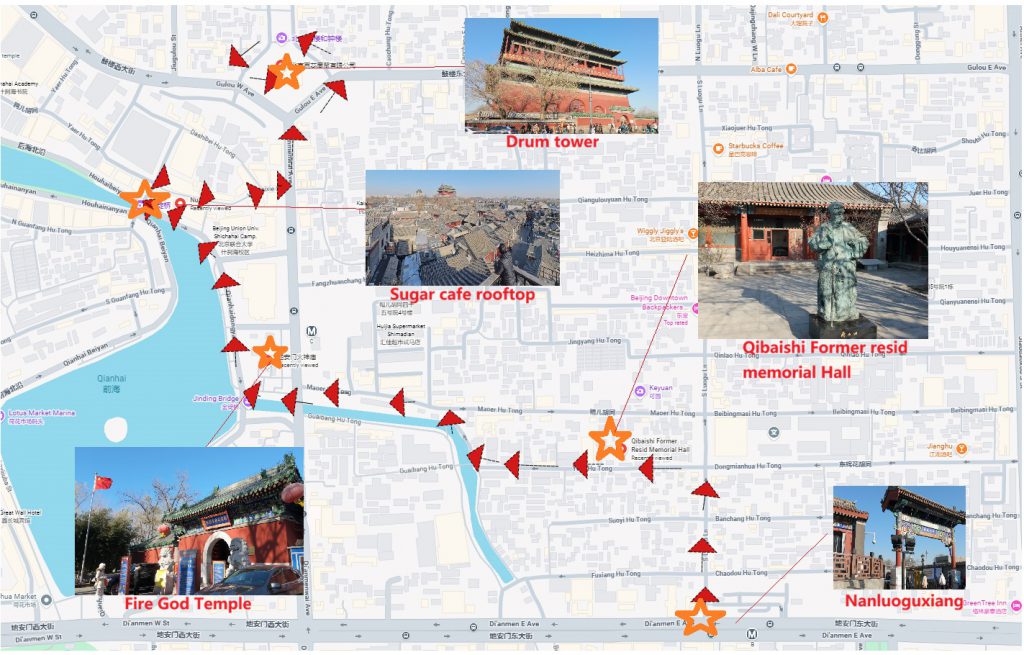
Starting point: Nanluoguxiang Subway Station
We’ll begin here. Nanluoguxiang is one of Beijing’s oldest neighborhoods. Although it’s quite lively now, just a few steps into the side alleys and you’ll instantly be surrounded by the authentic atmosphere of old Beijing. We won’t walk the entire main street—just enough to get a sense of it before turning into the nearby hutongs, where the real Beijing lives.
Former Residence of Qi Baishi
Once you enter Yu’er Hutong, the whole world suddenly quiets down. Not far ahead is the Former Residence of Qi Baishi. Qi Baishi was one of modern China’s most famous painters, especially renowned for his shrimps. This courtyard was his home in his later years—a neat and elegant siheyuan (traditional courtyard home) that’s free to enter. You can step into the courtyard, see the main house and side rooms, and imagine the master grinding ink and painting here. The courtyard isn’t large, but its layout is complete—a living example of a traditional Beijing home.
Temple of the Fire God
Emerging from the hutongs, you’ll see an expanse of water—this is Houhai Lake. Strolling along the lakeshore is very pleasant, and the red-walled, grey-tiled building along the bank is the Temple of the Fire God. This temple has a long history, dating back to the Tang Dynasty. It remains a popular place of worship today, especially its Yue Lao (Matchmaker God) Hall, which is filled with prayer plaques. Many young people come here to pray for love. If you’re interested, you can step inside to experience the serene yet lively atmosphere of a Chinese temple.
A view from above: Sugar Cafe
Walking along the lake, I’ll take you to one of my favorite hidden gems—Sugar Cafe. Its rooftop terrace offers an excellent view. Order a drink, and you’ll see an endless stretch of grey-tiled rooftops with the Drum Tower standing quietly in the distance. This is one of the best spots to look out over the hutong neighborhoods—especially in the evening when the light is soft, making it perfect for photos.
Final stop: Walk through Yandai Xiejie and climb the Drum Tower
After resting, we’ll wander into Yandai Xiejie—a small alley with a fun name, shaped like a tobacco pipe, now filled with interesting little shops. At the end lies today’s highlight: the Drum Tower.
In ancient times, the Drum Tower served as the timekeeping center of the city. Today, drum performances are still held here daily, full of energy. I highly recommend climbing the Drum Tower (a small ticket fee is required). Once you reach the top, you can look south toward the Forbidden City and Jingshan Park, and gaze north over a sea of hutongs spreading out like waves beneath you. That sense of historical grandeur can only be truly felt from the top of the Drum Tower.
📌 Helpful tips
· The whole walk is about 3 km. With a relaxed pace, photos, and breaks, 2.5–3 hours is ideal.
· The Former Residence of Qi Baishi is closed on Mondays. If your visit falls on a Monday, we can adjust the route.
· If you have the energy, you can also climb the nearby Bell Tower for a slightly different perspective.
This route is like a “folding of time and space”—you’ll experience lively streets, quiet homes, a lakeside temple, rooftop views, and finally stand atop the Drum Tower, taking it all in. It’s not too tiring, yet it truly captures the spirit of Beijing’s hutongs.
I hope you enjoy this “personal route.” Beijing has many more corners like this—I’ll show you more next time.